blog
Why I froze my own plugin compiler
When the part that differs between targets has to be written by hand anyway, a compiler only adds a step.
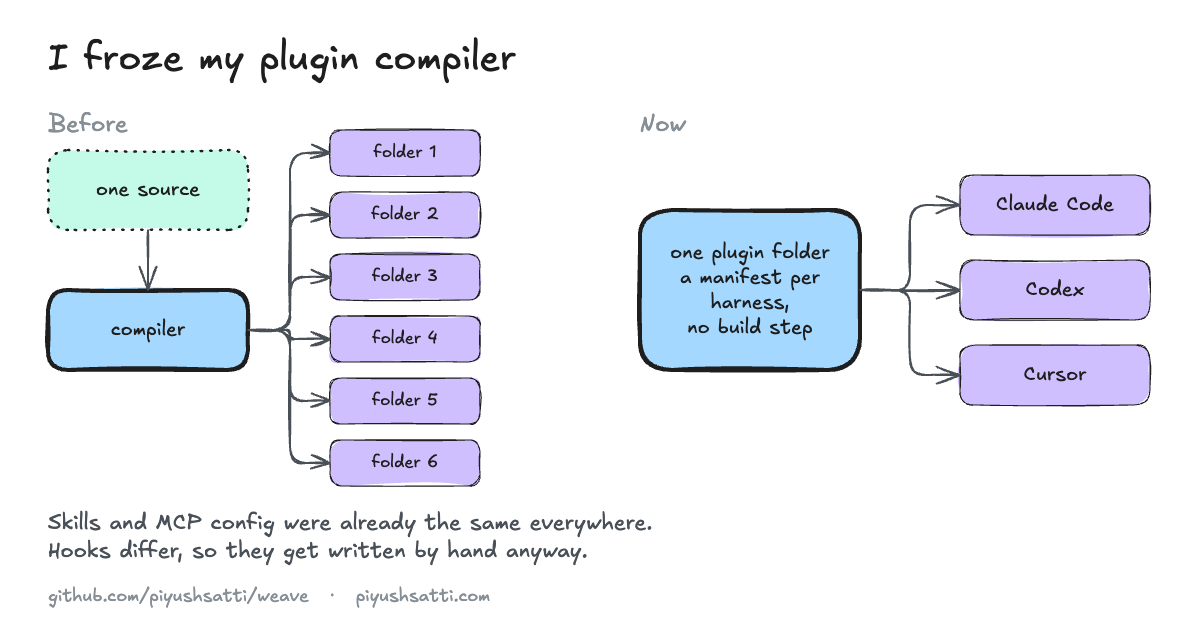
When the part that differs between targets has to be written by hand anyway, a compiler only adds a step.
A plugin is a bundle that adds abilities to a coding agent: skills (instructions the agent loads when it needs them), commands, hooks (scripts the harness runs at fixed moments) and MCP servers, which plug outside tools into the agent through the Model Context Protocol. Every coding-agent harness wants plugins in its own shape, with its own rules for where each of those goes. I was rewriting each of my plugins once per harness, so I reached for the idea behind the JVM: write it once, compile it for each target.
That was weave, and the compiling part worked. From one plugin source it wrote a finished folder for six targets: Claude Code, Codex, OpenCode, Pi, a portable package that Cursor and Copilot both read, and a set of repository instruction files. It started with crucible, a review plugin of mine, which I wanted in Claude Code and Codex without keeping two copies. When a target couldn’t hold something, weave refused to build instead of quietly shipping less. I froze it on October 22 because of one bottleneck: hooks are the part of a plugin that differs between harnesses, and they have to be written by hand for each one anyway.
How weave works
You write one plugin source: a manifest that lists the plugin’s skills, MCP servers and hooks, and the harnesses you want it in. When you tag a release, weave runs in the plugin’s own CI. A front end checks the manifest and builds one tree of everything the plugin contains. Then one back end per target writes that harness’s folder from the tree. Nothing gets built on the user’s machine: they download the folder for their harness and use it. Before writing the back ends I spent two days surveying nine environments to document what each one could carry, and three of them changed format while I was surveying.
The build stopped when a target couldn’t hold something
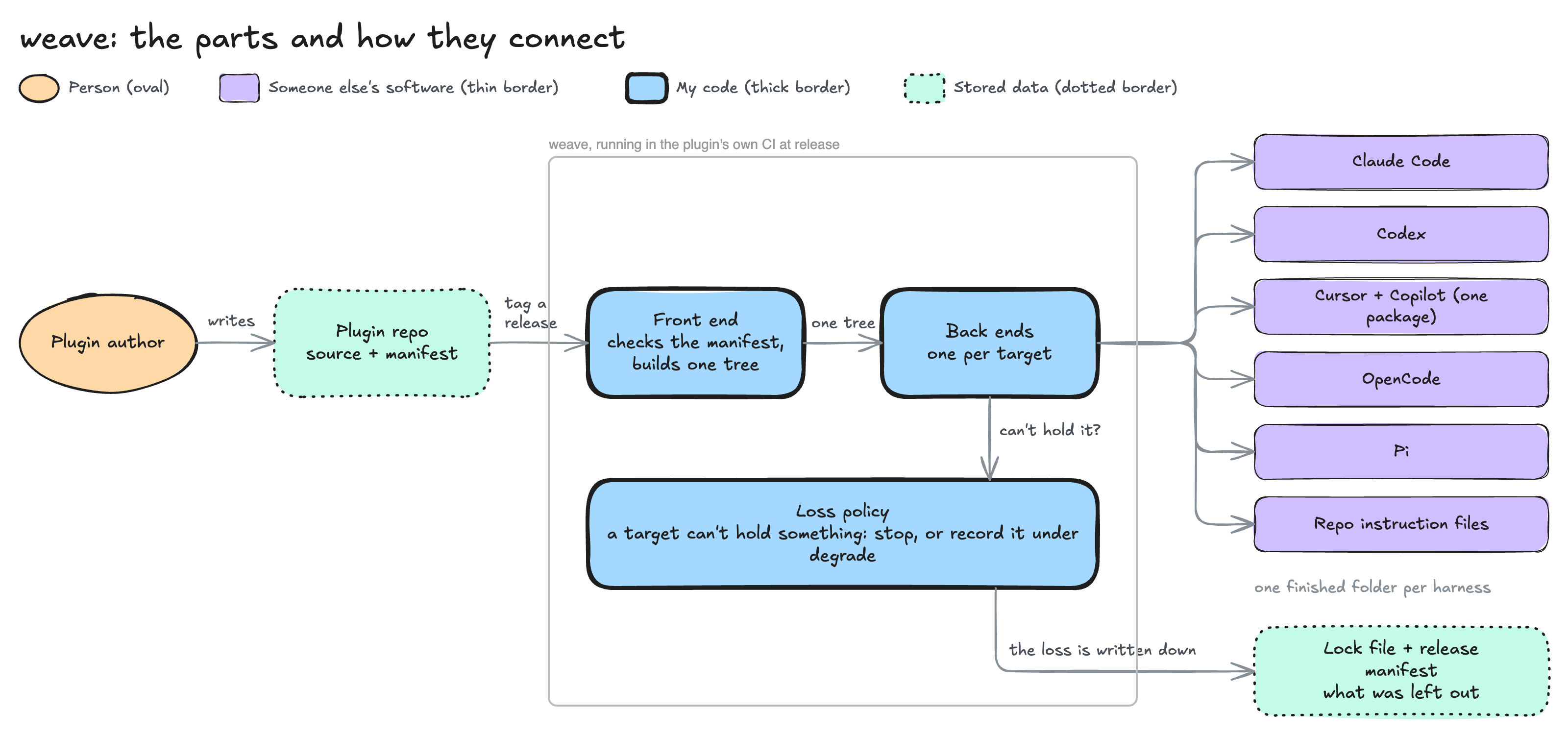
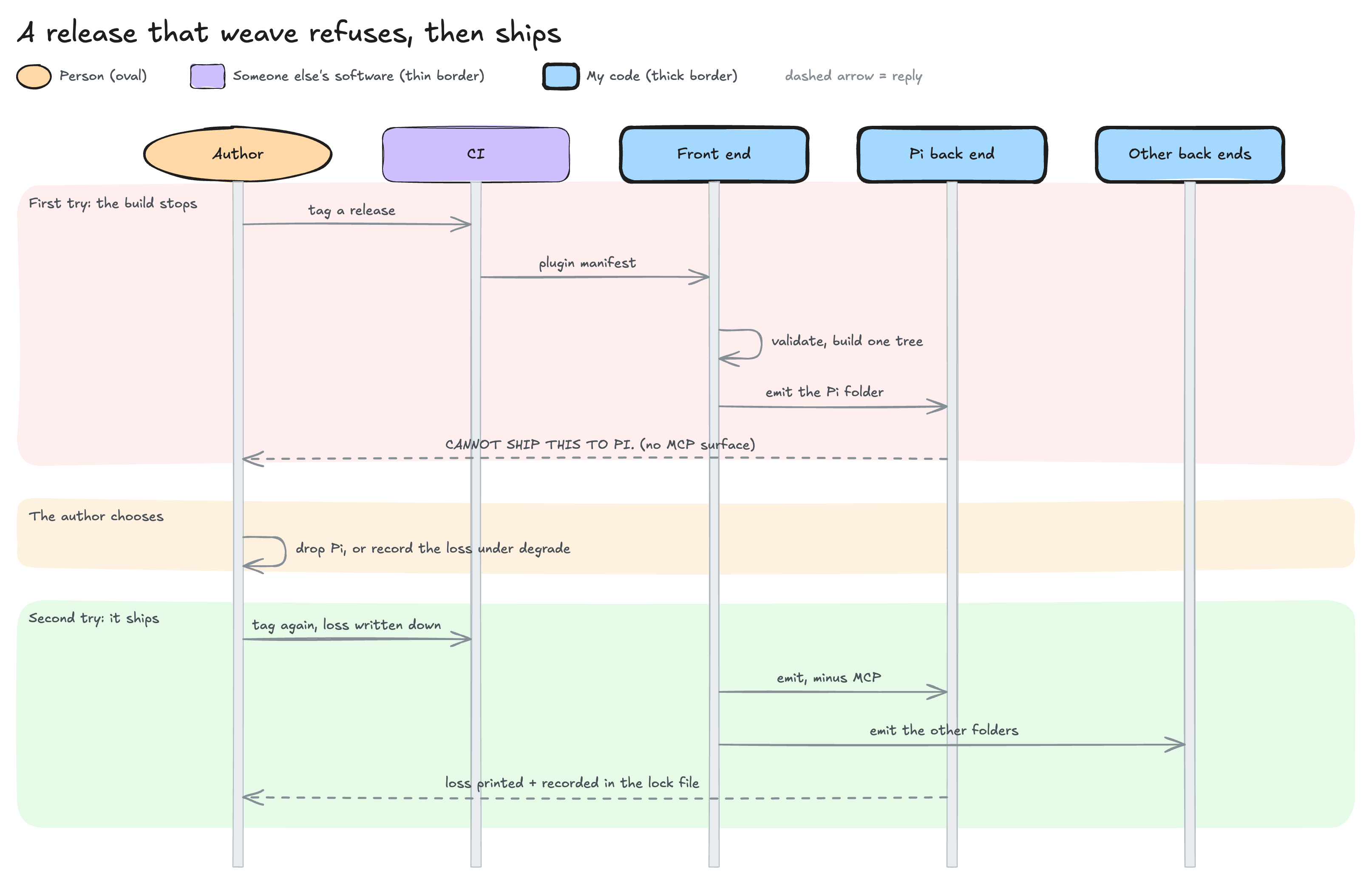
Pi has no MCP surface, and the portable package format defines no hooks or commands. When a plugin declared something a target couldn’t hold, the build stopped with a message that started CANNOT SHIP THIS TO PI. and named the item, the manifest line that declared it, and the reason.
The two ways forward were to drop that harness or write the loss down under a degrade key. A declared loss was printed during the build and recorded in a lock file inside each folder and again in the release manifest. This is the part I’m still proud of.
The bottleneck was hooks
The harnesses already share most of a plugin: a skill is a folder with a SKILL.md file in every one of them, and MCP config is close to identical, so a compiler had little to add for either. Hooks are where they really differ. The research I had just done on hooks for observational memory across Claude Code, Codex and Cursor showed that each harness has its own events and its own input shapes. weave had a neutral vocabulary of six hook moments, but Claude Code was the only harness it actually emitted hooks for. Those hooks have to be written by hand per harness anyway, and a compiler would only have generated the parts that were already the same.
I froze both compilers the same day
I had also started a second plugin compiler, inside the repository where I keep my machine setup and shared agent config, and on the morning of October 22 I added a Cursor target to it. A review that day compared it with weave, which had stalled in August, and found I was rebuilding the same compiler. I froze both: neither gets new targets or features, existing installs keep working from their last release, and nothing was deleted. It felt better than I expected: the refusal idea survived, and that was the part I cared about.
Now each plugin is one folder every harness reads
There’s no build step now. Each plugin is one folder that all three harnesses read directly, with a manifest per harness side by side, shared skills, two identical MCP files and a hooks folder with one script and one config per harness. A lint script checks that the manifests agree on name and version and that the two MCP files match.
A plugin counts as moved only when it is installed and runs in each harness it claims. I keep a verification ladder per plugin, with steps from lint checks at the bottom to day-to-day use at the top, and the date and the exact command for every step that actually ran.
The refusal and the ledger rule stayed
Each native plugin’s README now has a table per harness of what works and what is reduced or missing, which is the same idea as CANNOT SHIP THIS TO PI written as prose.
The decision ledger got a new rule. An entry is never edited to say something different; a later entry supersedes it, and the old one gets marked. The ledger’s README says the rule exists because weave stalled on two contradicting decisions: one entry said weave stays a single repository, while a template repository for it had been pushed a few hours earlier.
The weave repository is public and frozen at v0.1.2, and its README now says what works, where it stopped and why.